
Venus
Click on Venus in the model to learn more!
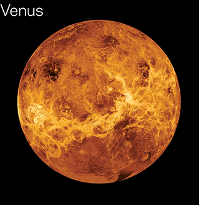
Earth's Sister
Venus is in many ways considered to be Earth’s sister planet. Venus is almost identical in size, chemical composition, gravitational pull, and density to the Earth. Put simply, Venus is made up of the same stuff as Earth, and in almost the same quantities.
However, If Earth and Venus are twins then Venus would be the Evil twin of the pair. Venus started out looking very similar to Earth but over time has changed into something far more hostile. There is still a lot we don’t know about Venus, due to the density of its atmosphere probes that visit the planet don’t last very long before being crushed. In the 1970’s the Soviet Union was able to land more than one probe on the surface of the world. The probes only survived a few hours before being destroyed by the pressure and heat of the planet’s atmosphere.
Atmosphere and Temperature
Temperatures on Venus can reach almost 900 degrees Fahrenheit (approx 482 degrees Celsius). In the early days of Venus' 4 billion year long life, it would have appeared very similar to the Earth. The two would have been almost identical, hence they are called twins. However, over a period of a few million years, forces on Venus caused it to take a very different course than the Earth. Venus lies much closer to the Sun than does our planet. That single fact has caused an unstoppable chain of events that doomed Venus to its fiery existence. Owing to its closer proximity to the Sun, Venus' temperature should have been only slightly warmer than that of the Earth. But as the planet warmed, the water evaporated.
The dramatic increase of water vapor in the atmosphere began a cycle of global warming that could not be stopped. Water vapor is a very effective greenhouse gas. (Greenhouse gas soaks up hot air and prevents it from escaping into space). The same principle is used in Saunas. The increase in water vapor caused the temperature to rise further, which caused more water to evaporate, which continually increased the planets’ temperature. Today it is likely that all of Venus' water has evaporated into the atmosphere. This atmosphere effectively traps the Sun's energy causing the surface to burn much hotter than it naturally would.
Gravity
Because Venus and the Earth are almost the exact same size, you would weigh almost exactly the same on either planet. The gravitational constant on Venus is 8.87 m/s compared to Earth's which is 9.81 m/s.
Moons
Venus does not have any moons.