
Earth
Click on Earth in the model to learn more!
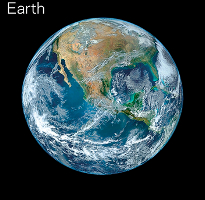
Our Home
Our planet is an oasis of life in an otherwise desolate universe. We have yet to identify any other forms of life outside of our planet. The Earth's temperature, weather, atmosphere and many other factors are just right to keep us and all life on Earth alive.
The Earth is the biggest of all the terrestrial or rocky planets. A terrestrial planet is a dense planet found in the inner Solar System. The terrestrial planets are Mercury, Venus, Earth, and Mars. The diameter of Earth is 7,926 miles. The circumference measured around the equator is 24,901 miles. There are currently almost 7 billion people living on the Earth and an estimated 8.7 million different species of life. About 30% of the Earth's surface is covered with land, while about 70% is covered by oceans.
Atmosphere and Temperature
Earth is the only planet in the solar system with an atmosphere that can harbor and sustain life. Not only does it provide us with the necessary oxygen we need to survive, but it also protects us from the harmful radiation and heat put off by the sun. Earth’s atmosphere is composed of 78% Nitrogen, 21% Oxygen, 0.93% Argon, and 0.038% Carbon Dioxide.
Earth’s atmosphere is about 300 miles thick, while the most prominent and dense parts lie within 10 miles of Earth’s surface. Earth’s atmosphere is broken into 5 layers; the troposphere which is the closest to Earth, the stratosphere, the mesosphere, the thermosphere, and the exosphere.
Due to Earth's atmosphere, temperatures are kept under relative control. The hottest ever recorded temperature on Earth was 136 degrees Fahrenheit while the coldest temperature ever recorded was -126 degrees Fahrenheit.
Gravity
The gravitational constant on earth is 9.81 m/s. Of the rocky or terrestrial planets, Earth has the highest gravitational pull thanks to its shear size and molten core.
Moons
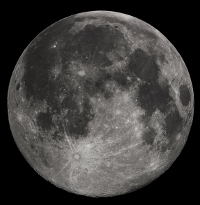
Earth has one moon formally named Luna. Due to its orbit relative to the Earth and Sun, the moon undergoes lunar phases causing us on Earth to see different shapes of the moon throughout the month. The moon takes 27 days to complete its orbit around Earth. The moon's rotation matches its orbit, so one side of the moon is always facing away from Earth.