
Neptune
Click on Neptune in the model to learn more!
The Second Ice Giant
Neptune is the smallest of the four gas giants in our Solar System. Much like Saturn and Uranus, Neptune's atmosphere contains hydrogen, helium and methane. For many centuries humanity did not know that this planet even existed. It was discovered by Johann Galle and Heinrich D'Arrest in 1846 utilizing mathematical predictions versus regular observation, a first for humanity.
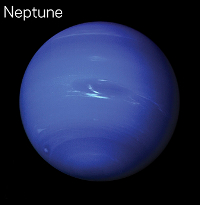
When Voyager 2 visited Neptune, its pictures showed a giant storm much like the storm on Jupiter. This storm is called the "Great Dark Spot" because it appears as a dark oval shape on the surface of the planet. We do not know how long this storm has been active or if it is still present. Neptune is a very windy place. No other planet in the Solar System has winds that are as strong as Neptune's. The winds near the Great Dark Spot were believed to have reached nearly 1,200 miles per hour.
Neptune has six rings which circle the planet. These rings are believed to be fairly new. The rings are more irregular than the rings of other planets. There are areas of varying thickness throughout the rings.
Atmosphere and Temperature
Neptune's atmosphere is very similiar to its far neighbor Uranus. Composed of 80% Hydrogen, 18.5% Helium, and 1.5% Methane. Unlike Uranus, Neptune has clouds and vibrant colors versus the featureless surface of Uranus. Neptune also has the most violent storms of the Solar System, with storms generating winds in excess of 2000 miles per hour.
Neptune has an extremely cold outer atmosphere due to its composition and vast distance from the Sun. Ironically, Neptune has a warm core, in fact Neptune receives twice as much energy from its core than from the Sun. Temperatues on Neptune are extremely cold, with temperatures in the outer atmosphere averaging around -364 degree Fahrenheit and temperatures at its core averaging around 9000 degrees Fahrenheit.
Gravity
Much like other gas giants, Neptune is massive in size however it lacks a strong gravitational field due to its composition. Neptune's gravitational constant is 11.15 m/s^2. Compared to Earth's gravitational constant of 9.81 m/s^2, you would weigh roughly 25% more on Neptune.
Moons
Neptune has 13 confirmed moons and 1 more awaiting official confirmation. Due to its distance from Earth, study of Neptune's moons is a difficult process and wasn't possible until recently.