
Jupiter
Click on Jupiter in the model to learn more!
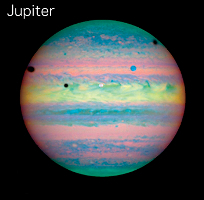
The First Gas Giant
Jupiter is the largest planet in our Solar System. The Earth could fit inside Jupiter more than 1000 times. Jupiter is considered a gas giant because it does not have a solid surface. Under its atmosphere is a large liquid ocean of hydrogen and water. What lies in between that ocean and the atmosphere? Actually, there is no in between. The atmosphere slowly gets thicker and thicker until it becomes part of the ocean. In other words, Jupiter's ocean has no surface on which you could float a boat. The sky becomes the ocean.
Jupiter is a very stormy planet. There are storms found throughout the atmosphere, most of which never seem to end. The many different cloud formations and storms in the atmosphere also make Jupiter a very colorful planet. Jupiter has 3 faint outer rings. They can be seen when Jupiter passes in front of the sun.
Atmosphere and Temperature
Jupiter is a gas giant, meaning that it's atmosphere is mostly made up of gasses, namely Hydrogen and Helium. Due to the density of Jupiter's gases, Jupiter has an extremely powerful magnetic field, the strongest in our solar system.
The temperature in the clouds of Jupiter averages at -229 degrees Fahrenheit. Meanwhile, the temperature near the planet's center much hotter, about 43,000 degrees Fahrenheit, which is hotter than the surface of the Sun.
Gravity
Due to its massive size, Jupiter has an extremely strong gravitational pull. Jupiter's gravitational constant is 24.79 m/s^2, meaning that the gravity on Jupiter is roughly 3 times stronger than Earth's. You would weight 3 times more on Jupiter than on Earth.
Moons
Jupiter has many moons, 67 to be exact. Jupiter has 50 confirmed moons and 17 unconfirmed moons ranging in size and composition. On of Jupiter's most notable moons is Europa. Europa is considered to be a prime suspect for liquid oceans and possible, life.