
Pluto
Click on Pluto in the model to learn more!
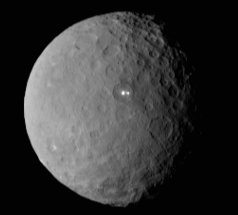
Sorry Pluto
Due to its small size, on August 24th, 2006 Pluto lost its status as a planet and was reclassified as a Dwarf Planet or Plutoid. Plut is about a third of the size of Earth's moon.
Pluto rides on a very eccentric orbit on a different plane than the rest of the planets in our Solar System. This eccentric orbit causes Pluto to routinely orbit inside of Neptunes orbit, putting it closer to the Sun at times.
Atmosphere and Temperature
Pluto has a very small thin atmosphere mainly composed of Nitrogen but also has large amounts of Methane and Carbon Dioxide. As Pluto moves away from the Sun, the Atmosphere freezes and falls to the surface of the planet.
Pluto is incredibly cold. With an average surface temperature of -381 degrees Fahrenheit and a maximum of -361 degrees Fahrenheit. Ironically, Pluto's atmosphere is actually warmer than its surface. This is due to the presence of large amounts of Methane. The average temperature in the atmosphere is around -292 degrees Fahrenheit.
Gravity
Unlike its closest neighbor Neptune, Pluto is extremely small and rocky. Due to its small size Pluto has a weak gravitational field. With a gravitational constant of 0.62 m/s^2 you would way less than 10% of what you weigh on Earth, on Pluto.
Moons
Pluto has 4 moons. The largest is named Charon. Charon is only slightly smaller than its parent Pluto. For this reason, Pluto and Charon are often called a double planet system.